
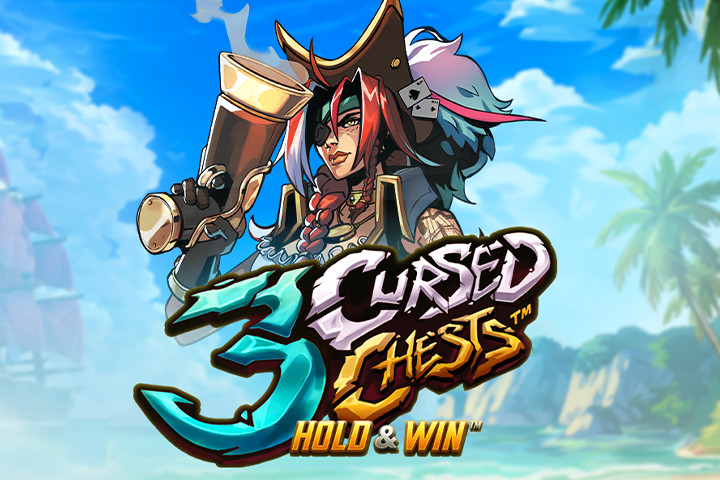

Three chests sit on the board, each glowing a different colour, each holding a different bonus. That's the whole pitch of 3 Cursed Chests, and it's worth walking through what actually happens once one of them pops.
The base game: what's actually on screen
Hacksaw Gaming built this one on a standard 5 reel, 3 row grid, so anyone who has spun a slot before will recognise the shape immediately. Wild symbols substitute for everything except the scatters, and those wilds are what stitch together the smaller wins while the player waits for something bigger to trigger. The pirate treasure hunt dressing (ropes, gold coins, cursed skulls, the three chests themselves) sits over that grid without changing how it behaves. With a hit frequency of 32.47%, roughly one in three spins produces some kind of paying combination, so there's a steady rhythm to it rather than long silent stretches followed by a jackpot swing.
Triggering the chests: the moment everything changes
Scatter symbols are the key that unlocks the three cursed chest bonuses, and this is the point where the slot stops looking like a normal pay-line game and turns into something closer to a pick-and-reveal format layered on top of Hold and Win. Land enough scatters or bonus symbols and one of the three chests activates, each awarding a different bonus. It isn't one fixed free spins round; it's a branching outcome depending on which chest gets unlocked, and that variety is what gives the feature its replay value. Anyone who has played other Hold and Win slots will recognise the underlying respin engine, but the chest-selection layer on top is the part unique to this title.
Hold and Win and the respin engine
Once a chest bonus fires, the game drops into its Hold and Win mode, the mechanic that does most of the heavy lifting for the bigger payouts. Bonus symbols land on the grid and lock in place, and every symbol that appears alongside them resets the respin counter. The round keeps going as long as new bonus symbols keep showing up, and it ends only when the respins run out with no new locks. This is the same core loop that made Hold and Win a genre unto itself, and it's why the tension works: watching one or two empty spots on an otherwise full grid, waiting to see if the last respin lands something.
Free spins, feature buy, and the ceiling on wins
Alongside the chest-triggered Hold and Win rounds, scatter symbols can also set off separate free spins features, giving the game two distinct routes into bonus territory rather than one. Players who don't want to wait for scatters to line up have the option to buy directly into a bonus round through the feature buy, paying a lump sum upfront to skip straight to a chest or a free spins session. It's a costed shortcut rather than a guarantee of anything bigger, since the outcome inside the round is still random.
The payout ceiling on all of this is 2,500x the bet. That's a modest ceiling next to the multipliers seen on some high-volatility slots, and it lines up with the medium volatility rating: swings are real but contained rather than boom-or-bust.
Who this actually suits
The 96.3% RTP puts it in a fair position relative to the wider market without being exceptional either way. Combined with the 32.47% hit rate, this reads as a slot built for players who want regular activity on screen and don't need a five-figure multiplier to feel like the session was worth it. Anyone chasing the very top end of the biggest slot wins should look elsewhere; anyone who wants a pirate-themed Hold and Win game with three genuinely different bonus routes and a bet range from $0.10 to $400, plus a feature buy for skipping the wait, will find exactly what's advertised. It sits as one of the more approachable Hold and Win entries in Hacksaw Gaming's catalogue rather than one of the studio's high-drama releases.
Bottom Line
Whether 3 Cursed Chests is worth your time depends on your tolerance for variance and how the theme reads to you. Players who want the slot's specific feature mix and accept the volatility profile will find consistent engagement here; players who prefer steadier, lower-ceiling action should look at lower-volatility alternatives. The math model and feature design tell you who this is for, the choice to spin is yours.