
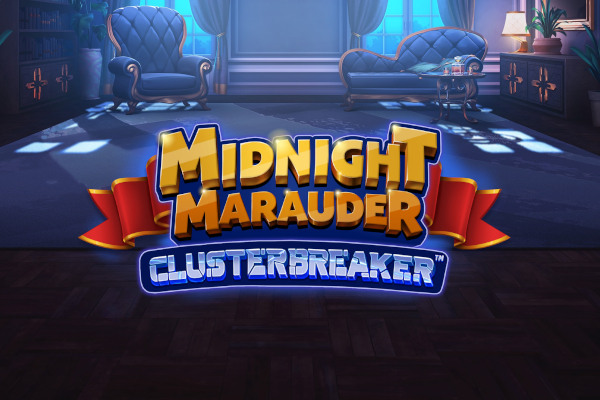



Sixteen tiles, and Midnight Marauder ClusterBreaker treats every one of them like it matters. On a wider board a single cluster feels like a drop in the ocean. Here, with only sixteen positions to fill, a cluster of five or six matching symbols already covers a third of the screen, and everything built into the game feeds back into that mechanic. Alongside the ClusterBreaker system itself, the game layers in a multiplier wheel, symbol collection mechanics, and multiple bonus modes built around its thief character theme.
What the ClusterBreaker mechanic actually does
Cluster pays slots normally work the same way every time: land five or more matching symbols touching horizontally or vertically, they pay, they vanish, new symbols drop in. Midnight Marauder ClusterBreaker keeps that skeleton but adds a wrinkle worth naming. Symbols can be broken down into smaller matching symbols to build larger clusters, so a near-miss cluster isn't necessarily dead weight, it can be converted into pieces that feed a bigger match. On a 4x4 grid, that kind of restructuring changes the shape of the board substantially, which is why wins here can cascade several times in a row when the grid is running hot.
The practical effect is a game that looks quiet between hits and then clears large sections of the board in a burst. The 20.58% hit frequency means a cluster forms on roughly one in five spins, so there is real waiting between paid outcomes. This is a rhythm familiar to anyone who has played high-volatility slots before: long flat stretches, punctuated by a sequence where the breaker mechanic keeps the board active for several cascades before it resets to blank tiles again.
Reading the numbers on the 4x4 board
The RTP sits at 96.1%. The max win is capped at 10,000x the stake, achieved through the cascading breaker sequences rather than a single bonus round jackpot moment. Put a $1 spin into the game and that ceiling translates to $10,000 for the rare run where the symbol breakdowns line up and the cascades keep stacking. Betting ranges from $0.10 up to $100 per spin, so the same math scales linearly whether it's played as a low-stakes session or a larger one.
High volatility paired with a sub-21% hit rate means the bankroll needs to absorb a fair number of scoreless spins before a cluster lands, and then absorb the fact that most of those clusters will be modest rather than grid-breaking. The appeal of the ClusterBreaker mechanic is that it gives every partial cluster a chance to become something bigger than its base pay, since breaking a symbol down is effectively free material for the next cascade. That's a meaningfully different risk profile from cluster slots without this kind of breakdown mechanic, where a cluster win is simply a cluster win and the board resets flat.
Who should spin it and who should skip it
Midnight Marauder ClusterBreaker suits a player who enjoys watching a grid work rather than just clicking through flat wins on a payline slot. The 4x4 format is compact enough that a session feels quick even when nothing much happens, which matters given the volatility here demands patience. The multiplier wheel and symbol collection layers, plus the multiple bonus modes tied to the thief character, give the format more to chew on than a bare-bones cluster grid.
It's not a fit for players who want frequent small wins to keep a balance ticking over, since the hit frequency is built around occasional bursts rather than steady drip-feed payouts. It also isn't the slot to reach for chasing the single biggest number on record; 10,000x is a real ceiling but far from the highest multipliers in the market. For a compact high-volatility cluster grid with a mechanic that actually changes how the board behaves rather than just relabeling a standard cascade, it does what it sets out to do.
Bottom Line
Whether Midnight Marauder - ClusterBreaker is worth your time depends on your tolerance for variance and how the theme reads to you. Players who want the slot's specific feature mix and accept the volatility profile will find consistent engagement here; players who prefer steadier, lower-ceiling action should look at lower-volatility alternatives. The math model and feature design tell you who this is for, the choice to spin is yours.


